
Welcome to Foresight and Insight.
The Hartford�s Group Benefits Division is pleased to provide updates on newsworthy legislative and regulatory actions related to group disability and life insurance. Periodically, we�ll also offer more in-depth reports on workplace, workforce and benefit trends.
In the August 2009 edition:
Are your employees hitting the wall?
A Disability Management Employer Coalition (DMEC) Think Tank reports that employers should be concerned about the impact of employee stress on profitability, healthcare costs and productivity. Despite the economic downturn and corporate downsizing, employers’ recognition of the problem has not driven them to action, according to the report. The Think Tank offers some innovative solutions to promote a healthier work environment and sustain productivity.
- Read the full article
Benefits that help employees reduce stress
A recent Hartford study shows that three out of four U.S. workers feel stressed. And, they consistently rank financial concerns, work issues and work-family balance among their top five stressors. So it’s not surprising to find that employers are interested in the latest benefits and services that can help them reduce lost work time, increase productivity and lower health care costs.
- Read the full article
Seeking benefit cost-saving solutions in tough times
Economic conditions are forcing many employers and employees alike to take a second look at their company-sponsored benefits. They want innovative, quick and easy tools to help them keep costs down and make more informed decisions. Insurance carriers are challenged to address these issues in a variety of ways.
- Read the full article
Are your employees hitting the wall?
“Extreme Productivity – Are your employees hitting the wall?”
A Special Report on Stress at Work from the Disability Management Employer Coalition (DMEC)
“There is a strong business case for paying attention to stress – both physical and behavioral – that results from overwork.” So states a DMEC white paper, “Extreme Productivity: Are your employees hitting the wall”1 in presenting a statement of the problem.
Think Tank participants questioned: At what point will our workforce surpass optimal productivity? and When employees – both white-collar and blue-collar – hit the wall, who pays the price?
Background
Since the 1990’s, companies have been introducing new business processes and technologies enabling them to do more, faster and cheaper. This has been good for consumers, who have benefited from greater product and service choices, higher quality and lower costs. But there’s been growing concern about how new “extreme productivity demands” affect the physical and mental health of the people working on the front lines of our new economy.
Now, in the midst of the most serious economic downturn in decades, as companies are shedding jobs and cutting costs at an accelerated pace, those employees who are still at work are being asked to be even more productive. So the challenge for employers is this: How do you keep your people performing at the highest level without burning them out?
That was the question addressed by the Disability Management Employer Coalition in its November, 2008 Think Tank. DMEC is an employer-based organization that advances the development of integrated disability, absence and productivity management processes in all disability related employer programs. It periodically organizes Think Tanks where key stakeholders and recognized experts explore current hot topics and develop associated best practices.2
Why should this concern employers?
Here are some compelling facts the DMEC offers:
- Stress is estimated to cost U.S. businesses an estimated $300 billion per year through absenteeism, diminished productivity, employee turnover and direct medical, legal and insurance fees.3
- Employees who say they are under uncontrolled stress spend 46 percent more on healthcare.4
- Productivity measures in the bellwether manufacturing sector declined by 1.7 percentage points during the third quarter of 2008 (prior to the economic downturn in the fourth quarter).5
Released in the second quarter of this year, the DMEC Think Tank’s white paper made three critical observations:
- There’s a strong business case for paying attention to stress resulting from overwork. Stress is a driver of reduced profitability, increased healthcare costs, and reduced productivity.
- Employers will realize a competitive advantage if they are ready to identify workplace issues and put in place programs that improve resiliency, reduce stress and promote employee work satisfaction.
- Best practice solution examples can be found for employers large and small, across various industries. These include training programs, work-life support services, and corporate culture initiatives.
The current financial crisis, economic recession and corporate downsizing can only be adding to worker stress levels and challenging the limits of extreme productivity. Yet, according to the DMEC, recognition of the problem has not driven employers to action.
What can you do?
Employers should consider some innovative solutions to promote a healthier work environment and sustain productivity. The DMEC white paper provides five examples from a diverse group of companies. Those cited include: GlaxoSmithKline, Union Pacific Railroad, Crowe Paradis, H-E-B Grocery Company and USAA.
Learn more
- Benefits that help employees reduce stress (see next article)
- View complete DMEC report
1DMEC 2008 White Paper dated March 2009.
2 The Hartford is a DMEC sponsor. Two Hartford Group Benefit Division representatives participated in this Think Tank.
3 American Psychological Association, APA Help Center, “Overwhelmed by Workplace Stress? You’re not alone.” Accessed November 15, 2008 Available: http://www.apahelpcenter.org/articles/article.php?id=164.
4 Substance Abuse and Mental Health Services Administration, “Comprehensive Mental Health Insurance Benefits: Case Studies,” Accessed December 4, 2008, Available: http://mentalhealth.samhsa.gov/publications/allpubs/SMA01-3481/SMA01-3481ch2.asp.
5 Bureau of Labor Statistics, 2008.
Benefits that help employees reduce stress
The Hartford’s Benefit Landscape Study shows that three out of four U.S. workers (73 percent) feel stressed. And, they consistently rank financial concerns, work issues and work-family balance among their top five stressors.1 Research estimates that 60 to 90 percent of doctor office visits are for stress-related problems and that the financial impact to both individuals and employers is in the billions.2 So it’s not surprising to find that employers are interested in the latest benefits and services that can help them reduce lost work time, increase productivity and lower health care costs.
The Hartford’s “Healthier, More Productive Employees” study of 100,000 employees and 22 companies showed that 52 percent of employees seeking Employee Assistance Program (EAP) services did so primarily for psychological or emotional reasons.3 Higher EAP usage rates may provide essential information for a company to realize the full influence of EAP on disability programs. The Hartford’s hypothesis is that employees are twice as likely to return-to-work after the conclusion of an absence when EAP and disability programs work together. The result would be a reduction of absenteeism and lost-time costs.
Some long-term disability (LTD) group insurance plans include professional EAP-type support to covered employees and their families in the event of an injury or illness that results in an LTD claim. Individuals can use these services for a specified number of years after the carrier has approved their claim. Help is available over the phone or face-to-face for work-life, family or marital problems, depression, childcare and elder care issues. A series of face-to-face counseling sessions may also be included.
Facilitating tough conversations
End-of-life planning is one value-added service area that’s emerging for Group Life Insurance products. Here’s why.
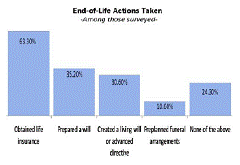 Ninety-four percent of people surveyed said it was somewhat to extremely important to discuss end-of-life issues with family. However, almost 40 percent of adults in the U.S. carry no life insurance at all, and 65 percent have not prepared a will (see chart).4 Furthermore, planning for end-of-life events ranks at the bottom of the list of actions taken.
Beyond traditional EAP programs, one value-added service helps insureds by offering information and tools on how to talk to family members about estate planning. Covered employees and their dependents can create a simple legal will online with the support of licensed attorneys.
While conversations about death are never easy, so-called funeral concierge services may offer valuable support in this sensitive area. Employers who offer group life insurance to their employees may include services such as unbiased advice from licensed funeral directors, funeral planning and cost-gathering information, price negotiating with local funeral homes and emotional support.
Support for beneficiaries
Of all life-changing events, the death of a loved one can cause the greatest stress. Programs offered as part of a life insurance policy are available to help beneficiaries cope with emotional, financial or legal issues in the event of a terminal illness or death. Employees may receive individual assessments and follow-up referrals outside the program when needed – 24-hours a day, seven days a week. A specified annual number of face-to-face sessions, or equivalent professional time, is available for any combination of emotional counseling, financial planning or legal advice. Counseling is typically provided by a firm that specializes in EAP support and referral services.
These services, which are designed to help guide employees through major life decisions, may be offered as a comprehensive package that greatly enriches a standard group life insurance product. Such benefit enhancements can provide additional peace of mind for both insureds and their beneficiaries.
Other value-added programs
Travel assistance and identity protection services are being offered to enhance products like Life, LTD and Accidental Death & Dismemberment (AD&D) insurance.
A typical travel assistance program may offer services such as:
- Toll-free emergency support when an employee, spouse or dependent travels 100 miles or more from their primary residence for 90 days or less;
- Assistance with visa requirements, medical referrals, repatriation; and
- Support for family members who seek to visit an insured while hospitalized in a foreign country.
Identity theft services are being offered as a value-added benefit, typically with business travel accident or AD&D insurance. In some cases, it is being added to life or disability contracts. One reason for its popularity is that identity theft is the fastest growing crime in America. And it has been the top consumer complaint to the Federal Trade Commission for eight years in a row.5
I.D. theft benefits generally take two forms: the most common are “restorative” – fraud resolution services that help insureds if their identity is stolen. These typically provide services like round-the-clock, toll-free support, a case worker and access to emergency cash and airline tickets. The other type of benefit focuses on “preventive” services. These may include features like monitoring, alert and report services for an employee’s Social Security number, credit card and public records. Online education, financial calculators and other interactive tools may also be packaged as part of this benefit.
The Hartford is committed to helping your employees and their families address life’s challenges by enriching its group products with value-added services. For example, The Hartford recently introduced Life Conversations, a first-of-its-kind program for employees covered under a Hartford Group Life policy. Life Conversations offers a comprehensive Web site that gives employees access to tools and resources related to life insurance and estate planning. It also provides at-need services such as funeral planning assistance from licensed funeral directors. And for beneficiaries, Life Conversations services include legal, emotional and financial counseling support to help families cope with a loss.
Contact your Hartford account representative to learn more about how The Hartford can help your company improve its productivity by helping employees reduce and manage life’s stresses.
1 The Hartford’s Benefit Landscape Survey, April 2009. For The Hartford’s survey, independent market research agency Opinauri, Inc., conducted an online survey polling 1,019 U.S. adults, aged 18-64, in April 2009. Survey data was re-balanced to a nationally representative sample of 1,109 U.S. adults aged 18-64. Additional over-quota interviews were completed to provide additional data for low-incidence groups.
2 Tonsfeldt, Darrin, D. The cost of stress. Keeping In Touch for Supervisors. The Village Business Institute. Third Quarter 2008. Available: http://www.villageeap.com/employer-resources/newsletters/3rd%20Qtr_Suprv.Newsltr08.pdf. July 14, 2009.
3 Healthier, More Productive Employees – A report on the Real Potential of Employee Assistance Programs (EAP), July 2007.
4 The Hartford’s Benefit Landscape Study, The Hartford. April 2009.
5 Federal Trade Commission Release dated February, 13, 2008. Available at www.ftc.gov.
Seeking benefit cost-saving solutions in tough times
Economic conditions are forcing employers and employees alike to take a second look at their company-sponsored benefits. They want innovative, quick and easy tools to help them keep costs down and make more informed decisions. Insurance carriers are being challenged to address these issues in a variety of ways.
Employers’ concerns
Concerned about controlling costs, employers are reviewing their benefit options, such as reducing 401(k) matches or lowering coverage levels. Some are looking at shifting costs by offering more voluntary benefits, such as retiree health care and Long-Term Disability insurance.
To date, however, disability benefits appear to be under-appreciated. According to The Hartford’s 2009 Benefit Landscape Study, while nearly 90 percent of employees participate in a health/medical insurance plan when offered by their employer, only 41 percent have STD coverage and just 36 percent have LTD insurance. It is apparent that employees continue to misunderstand and/or under value the benefit this insurance offers as a way to protect their paychecks.
Disability costs overall are a significant concern to employers. Employee disabilities can be costly to a company’s bottom line. On average, unscheduled absenteeism costs a large business more than $760,000 each year in direct payroll costs – even more when lower productivity, lost revenue and the effects of poor morale are considered.1
That may be one reason employers are seeking innovative solutions and technological support to help them get concrete numbers to track employee absences, monitor the reason for those absences and calculate productivity loss. In addition to valuing insurance carriers who provide dedicated return-to-work professionals to help get their workers back on the job quicker, they also want their carrier to take on more of the administration.
Another driver of employer interest in increased absence administration support is the Family and Medical Leave Act (FMLA). Nearly half of employers surveyed (49%) rank FMLA as the most challenging federal employment law to implement.2
Employee-friendly benefits
Employees want more bang for their buck, too. Not only do they want to keep their benefits, but they also want to better understand them. In fact, 46 percent of Americans say that because of recent economic events, they are taking a greater interest in understanding the benefits they receive.3
In addition, employees are looking for the ability to track their claims and receive quick and accurate payment. Increasingly tech-savvy and time-starved, employees today would value a single source to manage their benefits, complete with personal conveniences like:
- Seamless access to enrollment, beneficiary designation and evidence of insurability functions,
- Flexible, web-based solutions for year-round enrollment, and
- Immediate, automatic confirmation of coverage.
A smart system, end-to-end
Insurance carriers are also feeling the pressure of the tight economy. To compete effectively, insurance carriers need to examine and improve core technologies, such as data, analytics and workflow processes.4 This means being able to offer a complete end-to-end customer experience, including claims handling that goes beyond basic services.
Value-added services include smart workflow processes for better decision making and seamless interaction from the moment an insured enrolls in a plan through the time he or she files a claim. Easy access to such functionality backed by 24/7 enrollment call center support are just some of the features that state-of-the-art carriers are developing for today’s money-conscious customers and their employees.
Committed to harnessing the latest technological innovations for its customers, The Hartford recently introduced new benefits administration capabilities. Features are modular, so customers and/or their TPAs may choose the capabilities they wish. Examples include:
- Electronic eligibility data management for Group Life and Disability customers
- Single sign-on to evidence of insurability
- Customer-specific employee benefit micro-sites
- 24/7 enrollment support – employees can get personalized enrollment assistance from a benefits service representative via a toll-free line
Ask your Hartford account representative for more information about how The Hartford can best serve your group benefits administration needs.
1 Commerce ClearingHouse, 2007 Unscheduled Absence Survey.
2 Business & Labor Reports, www.blr.com, April, 2009.
3 Benefits Selling. Employer Data by ARAG. May 2009.
4 Kaytes, Dave and Josefowicz, Matthew. Technology and the Science of Customer Retention. Insurance & Technology. May 19, 2009. Available: http://www.insurancetech.com/business-intelligence/showArticle.jhtml;jsessionid=QGWDOCDNVFDR2QSNDLOSKH0CJUNN2JVN?articleID=217600037. May 27, 2009.